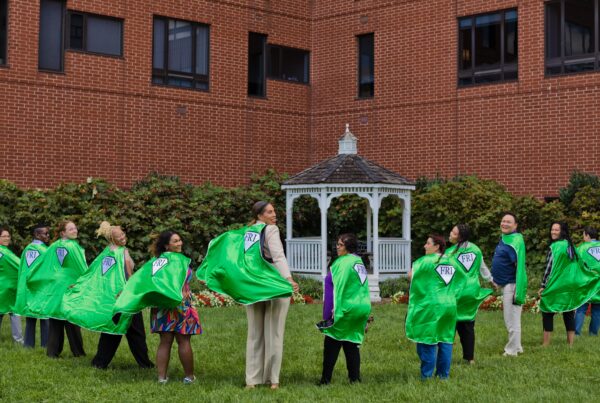

The Frontline Resource Institute (FRI) is guided by a Conceptual Committee of 10 environmental justice leaders from around the world. This blog post is the third in a series that will introduce you to FRI’s Conceptual Committee members, their motivations and vision for engaging with FRI and the environmental and climate justice movement, and some of the important lessons they have learned in their professional and personal journeys.
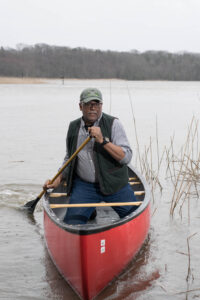
Today’s blog features Frederick Tutman, founder and CEO of Patuxent Riverkeeper in Maryland.
Provide an overview of your background and your professional work
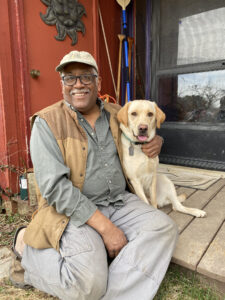 Prior to my work as a Riverkeeper, I worked for about 25 years in television and film production. I started a company in 1981 and worked as a freelance contract television writer, producer, and filmmaker for a range of media outlets. I spent most of that time working and living on the road, since union laws in the U.S. in those days forbade you from working within 150 miles of where you lived. So, I worked in locales far and beyond where I was based both here and abroad. I traveled to many places, including Argentina, Italy, Costa Rica, and Cuba; however, one thing I resented was that as a guy with a social conscience, I felt that wherever we went for work, we never helped anybody but ourselves. We reported or documented on human suffering, but we never did anything about it! So, I decided to change tracks and go to law school, thinking it might lead me into more humanitarian work.
It was after I exited law school three years later that I stumbled into the Waterkeeper universe. I had been volunteering for various watershed groups and had engaged in media work with environmental groups like World Wildlife Fund, National Wildlife Federation, and Keep America Beautiful. But it was when an acquaintance lent me the book, “The Riverkeepers: Two Activists Fight to Reclaim Our Environment as a Basic Human Right” that described the Waterkeeper movement to protect the Hudson River, and I learned how water activists were fighting oil tankers in New York Harbor using canoes and spears (and they were winning!), that I thought, wow, this is one hell of a movement and I need to be part of the action. So, I took the plunge and started Patuxent Riverkeeper. This work has changed me. It has changed how I think about the world and society — and it has changed my outlook in terms of my understanding of how society works and my place in the world.
What is your motivation to engage in the environmental and climate justice movement?
I believe that we have some obligation as human beings to try and make things better. That’s what galled me about the television work. We never made anything better, we never helped anybody. Our objectivity kept us aloof from the subjects we covered. But we pretty much captured people’s misery and we also made money off of that and that really offended my sense of social justice. Through my subsequent work and in the environmental and climate justice movement, we get in the trenches with people and experience what they are experiencing.
“We do work in places where the worst environmental health problems are because that’s where the work ought to begin; not in the richest neighborhoods, but in the poorest ones because that’s where the biggest environmental problems and challenges are likely to be found.”
What are some lessons learned from your involvement in the environmental and climate justice movement that you would like to share?
- It’s vitally important that people have agency over their own issues, concerns, and answers. The work that we do is intentionally leveraged by that in the sense that we take our orders from the communities that we serve and I think that’s durable and lasting work. If there ever was something that was sustainable, it’s work that people have a sense of ownership over. It belongs to them. They will pass it on to their kids. They will fight for it tooth and nail because it’s theirs and in the DNA of the surrounding community.
- Don’t make assumptions about who people are based on what they look like. For example, people of color often have deep connections to the environment, and yet we are presumed to be environmentally illiterate. In my case, I grew up on a farm and being outdoors, backpacking, fishing, and doing things that urbanites wouldn’t know much about. My knowledge base about the environment doesn’t track at all with what people would assume for an African American. The big green environmental organizations sometimes presume that everyone wants what middle- to upper- class white people want in some of the best zip codes in America. Their vision for the environment doesn’t usually include people who are suffering from toxic burdens or social disfranchisement. Their assumptions are deeply alienating and off putting for people suffering the worst privations you will find anywhere in the environment. These very recognizable environmental brands are often tone deaf and don’t know it.
What is your interest in engaging with FRI, and what is your vision for the organization?
“FRI represents the ethos that people can speak for themselves and hold their own ideas about the environment and connect to the environment on their own terms.”
What draws me to FRI is that, at its core, FRI is focused on supporting groups that are doing transformative work – essentially challenging unfair systems – and helping them find economic support and share knowledge among peers. We need to support these groups because it’s this transformative work that is changing the ground rules that are needed to win the game in grassroots activism, which is styled very differently compared to career-based work. We are not going to win on the same terms as people with all the money, resources, and social gravitas. We have to change the ground rules in a way that gives us a fair advantage. We have to move the needle to give communities some punch, some power, and so people begin to pay attention to the intolerable problems some of these communities face. My interest in working with FRI is to move that needle, to support work that in turn supports transformative and better outcomes for communities.
In terms of my vision for FRI, I’d like to see FRI thrive and survive. I sense that there’s a shift happening in the ethos of the country and the economy. People are throwing up their hands and walking away from what they think is wokeness. It isn’t woke. It’s what is decent and fair. The current administration has painted a target on anything that appears woke or involves diversity and inclusion. It’s not so much overt racism as it’s tone deafness and a decided preference and bias. Often, we struggle to cross the gulf between who we are and what people don’t know about us, us being those who are on the outside looking in. I have seen it for 40 years in my work with all these environmental groups, and the idea of consigning us to “diversity” roles is shocking and an insult. We are not diversity, we are stakeholders. So, what I hope for FRI is that it weathers this storm occurring in our society now, and those with resources continue to fund humanitarian and justice-based causes that embrace all. I think that’s hugely important!
What do you hope to see FRI accomplish in the next 10 years?
One of the big things I’d like to see for FRI is the organizations that FRI funds are prosperous and successful, and that they are able to secure a sustainable financial basis to continue the work indefinitely. FRI fills an important gap for values-oriented organizations, and that is, FRI’s values match those of the organizations they fund and the communities served.
Share a recent project you are proud of.
 I am proud of our coalition work to change the state regulatory scheme for how drinking water is regulated in mobile home parks. In Maryland, there is an assumption that simply enforcing the primary and very minimalist federal standards for safe drinking water is sufficient. The secondary standards address factors widely regarded as aesthetic such as color, taste, and smell. The result is that the operators of mobile home parks cut corners on those secondary standards and hold truly safe drinking water hostage by arguing that they will have to raise the rents and evict residents if they are forced to upgrade their water processing equipment to provide better drinking water. Poor people are forced to pay for dreadful undrinkable water as a result.

About the Author