
Reflections from FRI's Acting Director, Margot Brown, Sc.D., MSPH.
This year marks the 50th anniversary of Black History Month and the 100th year since Dr. Carter G. Woodson launched Negro History Week, a movement born of his devotion to showcase the contributions of Black Americans. Woodson chose the second week of February to honor the birthdays of Abraham Lincoln and Frederick Douglass. He believed, fervently, that Black people should be proud of their heritage¹.
Today, as we witness active attempts to erase, dilute, or sideline Black history across federal and state institutions, let me be clear: it does not make the truth less true. Slavery, Jim Crow, and systemic racism are not merely Black history: they are American history. And because they are American history, they belong to all of us. Our responsibility is not to flinch from the record, but to listen to it, fully, honestly, and together.
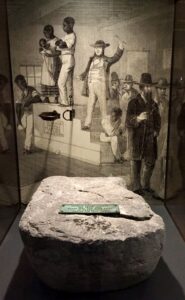
Auction block on display at the National Museum of African American History and Culture. Photo by Margot Brown.
A decade ago, I was fortunate to visit the National Museum of African American History and Culture on its opening weekend. I joined thousands of people in exploring “The Journey Toward Freedom: 15th to 21st Centuries” exhibit, where a deafening silence fell over the crowd. The words, images, and objects did not whisper. They boldly told the truth, and all around me, people were listening with stunned silence. These artifacts–from a slave ship captain’s diary to a slave auction block and a whip–were just a few of the hundreds on display that spoke powerfully for themselves.
“There is no Spaniard who dares to stick his head in the hatch without becoming ill… So great is the stench, the crowding and misery of the place… Most arrive turned into skeletons.” — Alonso de Sandoval (1627)
The exhibit held paradox and possibility side by side: unimaginable violence alongside undeniable progress. Near the end, a video looped of Barack Obama being sworn in as the 44th President of the United States. The juxtaposition, brutality and breakthrough, reminded me that the story of this nation is both an account of profound injustice and a record of movement toward a more just society.
When I stepped into the museum’s Contemplative Court, I reflected on James Baldwin’s words: “The great force of history comes from the fact that we carry it within us, are unconsciously controlled by it… history is literally present in all that we do.” Baldwin was right. We are, in so many ways, unconsciously guided by the stories we inherit, and by the stories we refuse to listen to.
This is why the truth matters: the truth will set us free, if we are willing to listen.
Today, freedom to speak truth to power is at risk. Two weeks ago, we witnessed two Black journalists being arrested for simply reporting the truth. When the stories of our past, stories of state-sanctioned violence and of tremendous Black ingenuity, leadership, and contribution, are erased or sanitized; we are all diminished. We have the power, and the obligation, to stop this erasure. We can do it through storytelling, and through listening to one another’s truths. Tell your story. And listen deeply when others tell theirs.
What story can you tell?
Tell a story of oppression.
Tell a story of accomplishment.
Tell a story of resistance.
Tell a story of hope.
But whatever you do, tell your story, and be willing to listen to the stories around you.
At the Frontline Resource Institute (FRI, pronounced “free”), we believe owning and telling one’s own story is imperative. Last year, we created a Best Practices Guide for Storytelling and Narrative Sovereignty. It offers practical ways for frontline organizations to document, build, create, and deploy narratives on their own terms, and guidance for external collaborators on how to support frontline storytellers without extracting or distorting their truths. Narrative sovereignty isn’t just a concept; it is a practice of listening with respect, consent, and humility, ensuring communities are not merely the subjects of stories, but the authors.
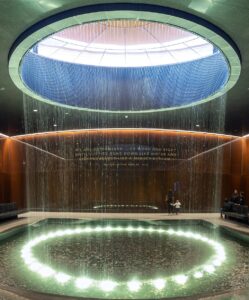
National Museum of African American History and Culture’s Contemplative Court. Photo by Rhododendrites.
Imagine if, every Black History Month, we captured, preserved, and uplifted stories of progress — not to paper over pain, but to carry history with us honestly. Imagine a shared record that holds both the harms and the brilliance: a light that reveals injustice, and a light that illuminates the way forward. When frontline communities, especially those at the crossroads of environmental and climate injustice, own their narratives and are heard, unconscious beliefs are challenged by the truth of lived experience. Policy shifts. Funding priorities move. Solutions become more grounded, more inclusive, more just.
This is how we begin to systematically address environmental inequities, by centering the people who live with them, by listening to what history has already taught us, and by trusting communities to lead with their own voices. This is possible if we are willing to listen.
Black History Month is an invitation and a challenge. It invites us to celebrate the vast contributions of Black Americans. It challenges us to confront the nation’s history without euphemism or evasion. And it calls us, especially those of us at institutions like FRI, to build infrastructure that protects truth-telling, honors narrative sovereignty, and cultivates a culture of radical listening.
The truth shall set you free—if you are willing to listen.
Let’s honor that truth, and Black history, by telling it, protecting it, and listening to it—together.
About the Author
Margot Brown, Sc.D., MSPH
Margot Brown, Sc.D, MSPH., is the Acting Director of the Frontline Resource Institute and Senior Vice President, Justice and Equity at Environmental Defense Fund.


.jpg)