
The Frontline Resource Institute (FRI) is guided by a Conceptual Committee of 10 environmental justice leaders from around the world. This blog post is the third in a series that will introduce you to FRI’s Conceptual Committee members, their motivations and vision for engaging with FRI and the environmental and climate justice movement, and some of the important lessons they have learned in their professional and personal journeys.
Today’s blog features Shamyra Lavigne-Davey, Executive Assistant at Rise St. James Louisiana.
Provide an overview of your background and your professional work
 I graduated from Southern University and A&M College in Baton Rouge in 2014 with an undergraduate degree in psychology. After college, I worked with adults and children as a behavioral and mental health specialist for six years. I then became a certified life coach in 2020 and launched my own business, Shamyra Elizabeth Coaching, LLC. In July 2020, I started working part time at Rise St. James Louisiana as the Executive Assistant to the Founder/Director of RISE St. James Louisiana, Sharon C. Lavigne. Rise St. James Louisiana is a faith-based nonprofit organization that is fighting the build out and expansion of petrochemical facilities in St. James, Louisiana, also known as Cancer Alley, and surrounding River Parishes. I continue to work there in that role to this day.
What is your motivation to engage in the environmental and climate justice movement?
We deserve clean air and clean water — these are basic human rights.
My motivation for engaging in the environmental and climate justice movement comes from my love for my family and community. I want my nieces and nephews to grow up in a clean, safe, and healthy environment where they can thrive. I am committed to resisting the expansion of the petrochemical industry and the continued industrial build out happening in our community. I do not want my community to be sacrificed so that corporations and the wealthy can profit at our expense. No one should have to live under these conditions, especially in a region known as Cancer Alley, where communities continue to face serious environmental and health impacts.
What are some lessons learned from your involvement in the environmental and climate justice movement that you would like to share?
- All it takes is one person to decide that they want to stand up and fight back against an injustice in their community. Once you stand up, you can start to get other people to join in and help you.
- Oftentimes state, local, and federal politicians and government leaders choose to turn a blind eye to what is going on in their communities for the right amount of money and funding from industries. Further, the U.S. EPA tends to protect industry more than the communities and the environment for which they were allegedly created.
- Putting money in the hands of people in communities with less restrictions eases the burden associated with traditional grant reporting and is much more of a help to the communities. A little bit of trust with those community members goes a long way.
What is your interest in engaging with FRI, and what is your vision for the organization?
I often make connections with an organization after they are established. So, I loved the idea of building something basically from scratch and being able to help shape and create it alongside people from across the country and the world. I was also drawn to the opportunity to lend my opinion and experience to help shape a committee that will cater to and facilitate the needs of frontline communities.
It is a committee that is for us, by us.
As for my vision for FRI, I would like to see FRI become a dependable powerhouse for frontline communities to lean on, a transparent entity that prioritizes areas that are often overlooked. I would like to see FRI go global at some point, but for now I want communities in the United States that look just like mine to see FRI’s resources poured into them first, and for those communities to get the most that they can out of those resources.
What do you hope to see FRI accomplish in the next 10 years?
In the next ten years, I would like to see FRI have a multi-million-dollar budget and the means to connect communities across the world so they too can benefit from its resources and the shared learning experiences of others like them. I want to see FRI as a leader in the environmental justice fight, using its ability to provide unrestricted funds and other resources to communities that need them. I want to see FRI hold yearly convenings where frontline communities can come together and share resources and experiences.
Share a recent project you are proud of.
During a recent toxic tour of Cancer Alley, I had the opportunity to work with students and a professor from Notre Dame. Together, we visited communities located on the frontlines of 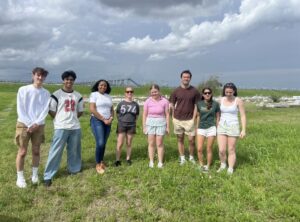 petrochemical pollution to better understand the environmental and health impacts residents face every day. The photo was taken in a cemetery located on the fenceline of a chemical plant, highlighting the harsh reality many communities live with. Experiences like this help empower young people to become advocates for environmental and climate justice.

About the Author