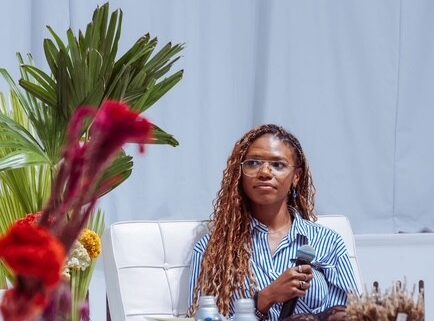
This month’s partner spotlight features an interview with Arielle V. King, a New York City based environmental educator, creative director, and host of "The Joy Report" podcast.
Arielle V. King is a proud environmental strategist and educator who uses art and storytelling to uplift climate activism. Arielle grew up in a predominantly Black and brown neighborhood in Albany, New York, which she describes as, “a food desert with the highest asthma rates in the city” due to disproportionately high levels of air pollution. The surrounding predominantly white neighborhoods had more green spaces and access to healthier food options. These differences led to health disparities within her community.
“Once I started gaining the language of environmental justice, which I began to develop when I was in undergrad, I studied environmental and sustainability studies with the intent to focus on understanding how we show up for the movement and the work that is required for us to create more equitable outcomes in environmental situations.”
At the predominantly white institution she attended, her curriculum wasn’t inclusive and neglected to highlight the environmental and conservationist work of people of color. “It was a very big culture shock to go to college and not see that reflected,” Arielle says. “That’s one of the many reasons why I’m so passionate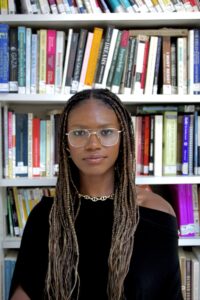 about contributing to, educating about, and amplifying the environmental justice movement.” Determined to investigate the intersection between racism and environmentalism, she focused her senior thesis on the environmental policy and collective action involved in the Flint, Michigan water crisis. This work affirmed the integral role visual media and storytelling play in advocacy. She saw how images of the rashes on children’s bodies and the brown tap water moved people to action, which prompted her to describe storytelling as “one of the most effective tools that we have for building and strengthening empathy and connection.” Her thesis introduced her to the history of the environmental justice movement and inspired her to pursue a master’s in environmental law and policy and a law degree with a specialization in civil rights and environmental justice. While at law school, Arielle co-founded the nation’s first environmental justice law society and created content on social media to make her education more accessible.
“In order to be an effective justice-focused lawyer, legal practitioner, or policymaker, a strong understanding of communications and storytelling is required.”
After earning her J.D., Arielle accepted an offer to host “The Joy Report” podcast. Intersectional Environmentalist, a nonprofit eco-media company, produces this podcast to promote climate optimism and  radical imagination, which Arielle defines as, “seeing the world as it is, believing something better is possible, and then working towards that better world.” Another objective of the “The Joy Report” is to remedy the rise in climate anxiety among Intersectional Environmentalist’s target audience — individuals ages 18 to 35. Consistent exposure to negative climate news can stun people into inaction. To mitigate this issue, in each episode Arielle offers listeners actionable steps to make a difference in the climate movement, especially at local levels. She believes and reminds listeners at the end of each episode that, “fighting the climate crisis is a marathon, not a sprint. We need everyone to get involved in ways that feel right for them, now more than ever. Our individual, positive actions do have power, and they’re strengthened when we do them as a collective.”
Throughout her time hosting “The Joy Report”, Arielle has highlighted frontline leaders driving solutions and stories dedicated to numerous areas of concern, such as justice-infused corporate social responsibility initiatives, ecosystem restoration, overcoming book bans, and anti-PFAS research. To name a few organizations, one episode features Justice Outside and The Solutions Project, who both granted over two million dollars in funds to BIPOC communities in the environmental movement. She prioritizes centering frontline voices because their lived experiences are the key to creating an inclusive, just environment. That said, Arielle recognizes the amount of pressure frontline leaders face and encourages them to rest without guilt.
“I think one of the exciting and important elements of finding and being in community with others is recognizing that none of us are doing this work alone. We’re all contributing to a movement far greater than us. And because we’re not doing this work alone, we can (and must) take breaks and tend to our mental health. We have a duty to work on becoming whole versions of ourselves so that we can give the best of ourselves to these movements.”
Arielle practices self-care and infuses joy into her daily life, while encouraging others to do the same. She enjoys listening to music, spending time in nature and with her community, and engaging with art, which she describes as “an important channel for staying connected to my brain and my body.” Arielle also enjoys reading memoirs, science fiction novels, and environmental books, such as marine biologist Dr. Ayana Elizabeth Johnson’s “What if We Get It Right”. Dr. Johnson also developed the climate action Venn diagram which proposes the most meaningful climate action lies at the intersection of your skill sets, the movement’s needs, and your sources of joy. “I use her climate action Venn diagram during workshops to help people recognize the power they possess to contribute to climate action, regardless of whether they’ve previously worked in the climate sector,” says Arielle, who enjoys reminding others that as long as they are authentically themselves, they will fulfill their purpose and benefit others along the way.
Listen to “The Joy Report” episode featuring FRI’s very own Dr. Margot Brown on Spotify or Apple Podcasts and share with your network! For more episodes, check out the Intersectional Environmentalist’s webpage.

About the Author